


Air Combat
Air Combat (Japanese: エアーコンバット Eā Konbatto) is the first console title of Namco's Ace Combat series, having previously been released as an arcade game. The original Japanese title for the game was Ace Combat (Japanese: エースコンバット Ēsu Konbatto); this became the prefix of each title in the series ever since.
Plot[edit | edit source]
In 1995, a well-armed coup d'état force rose up within the Skully Islands, an island nation south of Usea, quickly overwhelming the legitimate government. Attempts by the "loyalist" forces to fight back were foiled by repeated surprise attacks from the terrorist forces, preventing any possible chance of retaliation.
As a last resort, the government hired the mercenary Scarface Squadron. In exchange for their services, they would be compensated with economical rewards, as well as being recognized by the government as the "premiere top guns of the world." Thus, the mercenaries begin their liberation mission. Led by Phoenix, the squadron partook in several missions across the country, raiding vital insurgent-controlled sites such as oil refineries and liberating areas such as cities and military ports.
Eventually, they made their way towards the enemy's main stronghold at Scorpion Island, severing the base's connection to the mainland by destroying its air base and main suspension bridge. After an infiltration operation at a ravine in the country's northeastern region, the loyalist forces discovered that the rebels had a final trump card: a gigantic airborne forward base, which was detected approaching friendly territory. Scarface Squadron launched once more, intercepting the airship over the eastern ocean. The airborne fortress was eventually destroyed, and fell into the sea. Scarface was then contacted by a government official, who thanked them for their efforts in liberating the country and restoring the legitimate government.
Gameplay[edit | edit source]
Air Combat set the stage for most of the series' gameplay features, the most notable of which being an aircraft's ability to carry an unrealistic number of missiles and cannon ammunition. The game's main goal is to destroy all designated targets (marked "TGT") in each level. As they destroy targets, the player will gain money to buy new aircraft; as well, there are non-vital targets that will net the player with extra cash if they so choose to destroy them. The player can select an aircraft for each mission from a varied list (see below).
Due to the game's semi-realistic nature, it is perfectly possible to launch in aircraft not fit for certain missions (for example, launching in an interception mission with a ground attack aircraft). From mission 04 onward, the player will be able to deploy alongside a wingman. In the briefing screen, the player can give one of three orders to the AI ally, these being "Cover Me" (aircraft flies cover for the player), "Commence" (mission objective) and "On your own" (aircraft separates from the player and engages enemies at will).
Aircraft[edit | edit source]
Air Combat has several planes to choose from. Each plane has different strengths and weaknesses and it is up to the player to determine which aircraft best suits each mission. Unlike its sequels, Air Combat applies the same paint job (see cover art) to each plane once it is purchased.
Development[edit | edit source]
The making of Air Combat began after the release of the original arcade game in 1993, when Namco ordered the development of a PlayStation 1 port of the game. The team of programmers involved led by producer Kazumi Mizuno decided to instead make an original sequel because of existing hardware limitations, which made replicating arcade games impossible. The vibrant colors of the game, including the liveries of Scarface were an intentional design choice to emphasize its casual nature.[1]
Technical limitations prevented the team from implementing various ideas, including the ability to watch game replays later introduced in Ace Combat 2 and a system where accomplishing certain missions would affect future operations in various ways. A take-off/landing system was included just a week after the game had been submitted for approval, being in mostly working condition three weeks afterwards. As a result, copies with such sequences were available only to the programmer team.[1]
Mobile version[edit | edit source]

On August 25 of 2005, Namco released a mobile version of Air Combat for cellphones available for download through the "Namco Service", a game distribution network based on the Japanese EZweb mobile connection service, itself built on the BREW mobile application, priced at 525 yen.
It is virtually identical to the original title, with the core differences laying on the design of menus and HUD. Gameplay is absolutely unchanged, and three difficulty modes (Easy, Normal, and Hard) can be selected. The game became unavailable after the Namco Service was shut down in 2006, and was never released outside Japan.[2]
Gallery[edit | edit source]
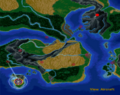
Skully Islands as depicted in Air Combat
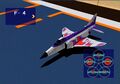
The F-4; note the lack of landing gear.
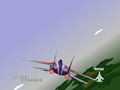
Screenshot, showing the F-14
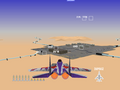
Another screenshot, showing the F-15 Eagle
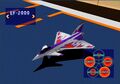
The Typhoon
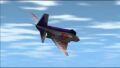
The F-4 Phantom, as seen in a cutscene
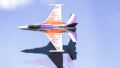
The F-16
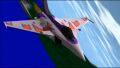
The Rafale
The YF-22
Japanese title
The F-14A Tomcat from the mobile version
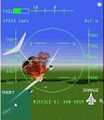
Mobile version
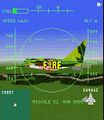
Mobile version


.png)
.jpg)


Trivia[edit | edit source]
- Air Combat is the only game in the Ace Combat series to have no fictional fighter designs.
- The story of the game was heavily altered in early North American copies and pre-release advertisement, portraying it in a manner reminiscent of the original Air Combat arcade game. According to promotional media and the back of early US releases, Scarface One is the leader of an "elite corps" of mercenaries hired by NATO to combat a "ruthless sect" of terrorists in locations across the world. As well, the Middle East was explicitly named in American magazine adverts, which compared them to the game itself.
- Air Combat is one of several PlayStation games to have been released in a "long box" format, with the game disc contained in a vertically elongated case. Early American releases used the long box model, prior to the adoption of the conventional jewel case in later releases.
- There are a bunch of unlockables hidden within the game which allows the player to active a selection of cheats and the Phoenix mini game.
References[edit source]
| Ace Combat games | |
|---|---|
| Numbered Series | |
| Secondary Games | |
| Spin-Off Games | |
| Other Games | |
| Unreleased | |