Air Combat 22
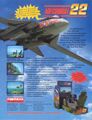
Air Combat 22[a] is an arcade flight simulation game developed by Namco and released in early 1995. It was built on the company's Super System 22 arcade board, hence the "22" in the game's title. Air Combat 22 is the sequel to Namco's 1993 arcade game Air Combat; both games were the predecessors to the Ace Combat franchise.
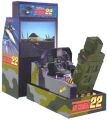
Air Combat 22 was available as a dedicated arcade cabinet or as a conversion kit for Air Combat cabinets. Compared to the original, which only had one mission and one playable aircraft, Air Combat 22 features two missions with multiple engagements, landing and refueling minigames, and three playable aircraft.
During the 30th Anniversary of Ace Combat, on July 3, 2025, Hamster Corporation re-released Air Combat 22 under the company's Arcade Archives brand. Arcade Archives AIR COMBAT 22 released on the PlayStation 4 and Nintendo Switch, featuring the original game, a high-score mode, a caravan mode, rewind and quick start functionality, and multiple local leaderboard save slots. Arcade Archives 2 AIR COMBAT 22 released on the PlayStation 5, Xbox Series X|S, and Nintendo Switch 2, including a time attack mode, variable refresh rate support, and all features of the Arcade Archives version. An upgrade pack is available for owners of the Arcade Archives version to upgrade to the Arcade Archives 2 version.[3]
Gameplay
Original
The original release of Air Combat 22 features two missions. The player's assigned squadron depends on the mission and difficulty they select. Both missions have a set time limit and the player earns more time as they destroy enemies; arcade cabinet owners could select between certain difficulty levels to change the amounts of starting time and bonus time awarded.
In the standard mission, the player must destroy all enemies in a series of engagements before time runs out. Three difficulty options are available: Cadet with tutorials, Cadet without tutorials, and Top Gun. Unlike Air Combat, multiple enemies will appear on screen at the same time. Halfway through the mission, the player must either perform an aerial refuel, a carrier landing, or an air base landing, all of which award bonus time. If the player runs out of time, they can insert more credits to continue playing, but their score will be reset.
- Cadet with tutorials shows "first-timer messages" that pause the game and instruct the player on how to play. Enemies are less mobile in this mode. The order of engagements on this difficulty is fixed and includes an aerial refueling and a final fight against an aircraft carrier.
- Cadet without tutorials features more mobile enemies. Most of the engagements are the same as Cadet with tutorials, but the second engagement will be different if the player clears the first engagement at an altitude of 1500 m or higher.
- Top Gun requires clearing Cadet without tutorials first. There are three branching paths, dependent on how many enemy aircraft the player shoots down with the Machine Gun, which can change the aerial refueling to a base or carrier landing, and can change the aircraft carrier fight to an attack on a base. After destroying the carrier or the base, the player will face a final fight against one enemy aircraft.
In the "Dogfight" mission, the player must shoot down as many aircraft as they can before time runs out. If the player shoots down 128 aircraft, they will complete the mission. This mission has no player-selectable difficulty option. As in Air Combat, enemies appear on screen one at a time. If the player runs out of time, the mission immediately ends; more credits cannot be inserted to extend the timer.
All three playable aircraft are equipped with a Machine Gun (dual Machine Guns on Cadet difficulty) and standard missiles, which can lock on to both air and ground targets and are mostly fire-and-forget. While the player can pitch up and down, they cannot crash; an autopilot will force the plane back into the air. If the player runs out of time in either mission, the aircraft runs out of fuel and the pilot is depicted ejecting from the aircraft. Players are awarded a rank at the end of the mission (whether it was successful or not) and, if their score is high enough, added to a local leaderboard.
The original arcade cabinet was flown with a throttle to the player's left and a flight stick to their front, designed to sit between the player's knees. The flight stick featured a trigger to fire guns and a thumb button to fire missiles. There was no yaw or roll control; moving the flight stick left or right simply banked the plane in that direction to turn. Other instrument panels and multi-function displays were shown in the arcade cabinet, but they were aesthetic and non-functional.
Arcade Archives
The Arcade Archives and Arcade Archives 2 ports feature multiple modes. In all but Original Mode, players can submit their scores or times to an online leaderboard but cannot change most settings.
- Original Mode is the original arcade experience. The player can freely insert credits using a button on the controller and change various settings that arcade cabinet owners had access to, including the time limit and bonus time awarded. Players can also rewind their gameplay in this mode.
- Hi Score Mode is similar to the original arcade experience, but the player only has one credit and cannot continue using more credits. If the player runs out of time, the mission immediately ends.
- Caravan Mode is a five-minute version of the "Dogfight" mission; the player must shoot down as many aircraft as they can in five minutes. The original timer (set to 60 seconds) is still present, so if the player does not shoot down enemy aircraft fast enough to keep earning bonus time, the mission will end prematurely.
- Time Attack Mode (exclusive to Arcade Archives 2) is a speedrunning version of the standard mission; the player must complete the standard mission as fast as they can. Each engagement is also separately timed. Even if the player does not complete the mission, they can still submit their times to the online leaderboard as long as they cleared the first engagement.
Additional options are available in both ports, including control remapping, screen borders, scan line filters, audio settings, and more. An in-game manual is accessible from both the main menu and the pause menu. The player can enable "quick start", which launches the last-played mode upon launching the game. The PlayStation and Xbox versions feature trophies and achievements, respectively, for starting each mode, earning high scores, and submitting scores to the online leaderboards.
Aircraft
Playable
After selecting a mission, the player can choose one of three aircraft. There is no functional difference between them.
Unplayable
- F-4E Phantom II
- F-16C Fighting Falcon
- AV-8A Harrier
- A-10A Thunderbolt II
- MiG-21bis Fishbed
- R-C01
- E-2C Hawkeye
- C-2 Greyhound
- C-130 Hercules
- B-52H Stratofortress
- B-2A Spirit
Soundtrack
Legacy
Cancelled PC port
In January 1996, Namco announced that the company was developing Windows 95 ports of Air Combat 22, Tekken, and Rave Racer using the first series of PowerVR chipsets.[5] The company developing the chips, VideoLogic, claimed that all three ports would appear at E3 in May 1996[6] and release that same month.[7] Only Rave Racer was shown at E3 and its port was incomplete.[8] The ports had not released by December[9] and they were officially cancelled in August 1997 due to "a protracted development period" that led to the games being "seriously delayed."[10]
Ace Combat
Two tracks from the Air Combat 22 Original Soundtrack, "If the Sky is Burnin' Out!" and "Surrender Me", were remade in 2011 (the former into an instrumental version) for Ace Combat: Assault Horizon Legacy. "If the Sky is Burnin' Out! (2011)" plays in Survival Mission 03 and "Surrender Me (2011)" plays in Survival Mission 04. Both tracks were included on the ACE COMBAT 3D: CROSS RUMBLE Original Soundtrack release. According to Air Combat 22 developer Hisaharu Tago, none of the original 22 staff asked Legacy's staff to include the tracks, but the latter informed the former and their inclusion made Tago happy.[11] "If the Sky is Burnin' Out! (2011)" was later added to Ace Combat Infinity as the background music for the Ring Battle stage Tokyo Sky Domination, and then to Ace Combat 7: Skies Unknown as a possible track in online multiplayer matches.
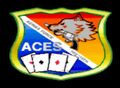
Trigger's emblem from Ace Combat 7: Skies Unknown is a homage to the "Aces Squadron" emblem; both feature a canine holding a revolver in its jaws.
The Airborne Warning and Control System that accompanies the player has the callsign AWACS Argus Eyes. An Osean AWACS in Ace Combat 7: Skies Unknown has a similar callsign, AWACS Argus.
Gallery
Arcade
Gameplay
Emblems
Footnotes
- ↑ Air Combat 22 (エアーコンバット22)
References
- ↑ Akagi, Masumi (13 October 2006). アーケードTVゲームリスト国内•海外編(1971-2005). Amusement News Agency. p. 53. ISBN 9784990251215.
- ↑ RePlay (April 1995). Namco Roars In To Its 5th Decade: Having Completed 40 Glorious Years of Coin-Op, "The Game Creator" is Going Stronger Than Ever. p. 146.
- ↑ 3.0 3.1 Hamster Corporation. "Arcade Archives AIR COMBAT 22". Arcade Archives. Retrieved on 30 June 2025.
- ↑ "『エースコンバット』へ至る道―『エアーコンバット22』と初代『エスコン』を繋いだものとは?開発スタッフがシリーズ初期を振り返る【特集】 2ページ目" ["The road to Ace Combat: What connects Air Combat 22 and the original Ace Combat? Development staff looks back on the early days of the series [Special feature]"]. Game*Spark. Published on 14 April 2019. Retrieved on 3 July 2024.
- ↑ "NEC/Namco PC deal...". EDGE issue #28, p. 11. January 1996.
- ↑ "PowerVR heralds new standard in PC 3D". EDGE issue #31, p. 13. April 1996.
- ↑ "NEC and VideoLogic enter 3D warzone". EDGE issue #30, p. 8. March 1996.
- ↑ "Rave Racer". EDGE issue #32, pp. 28–29. May 1996.
- ↑ "3Dfx vs PowerVR: Spearheading the PC3D revolution". EDGE issue #40, p. 57. December 1996.
- ↑ "Namco lacks Logic". EDGE issue #48, p. 9. August 1997.
- ↑ "『エースコンバット』へ至る道―『エアーコンバット22』と初代『エスコン』を繋いだものとは?開発スタッフがシリーズ初期を振り返る【特集】 2ページ目" ["The road to Ace Combat: What connects Air Combat 22 and the original Ace Combat? Development staff looks back on the early days of the series [Special feature] Page 2"]. Game*Spark. Published on 14 April 2019. Retrieved on 3 July 2024.